

Splicer · speed
Measured, not promised.
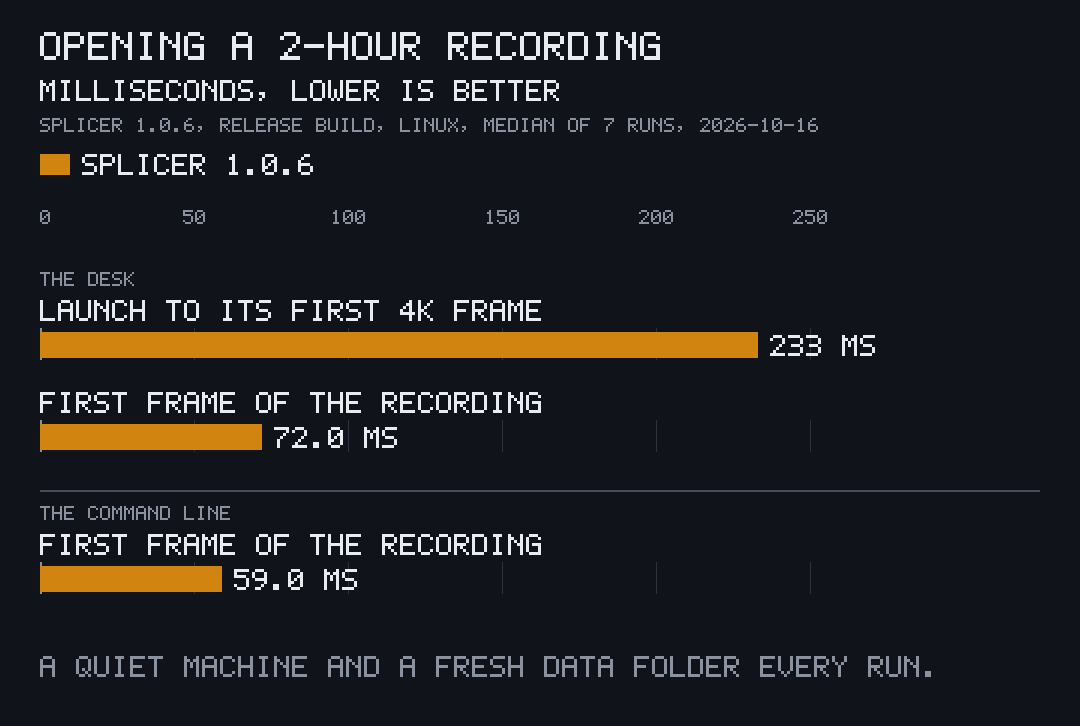
Every release is timed against the one before it on the same machine, and a step back of more than 5% holds it until Gamer Dad signs off. Release builds, only the timed command running under the GPU queue's bench class, two or three runs each with the median kept, on his own 2 h 07 min OBS recording (H.264 1920x804 with PCM sound in MKV, and its two-track copy). The charts are drawn by pito-compare, PITO MD's own chart tool.
- 72 ms from opening a two-hour recording to its first frame on the desk
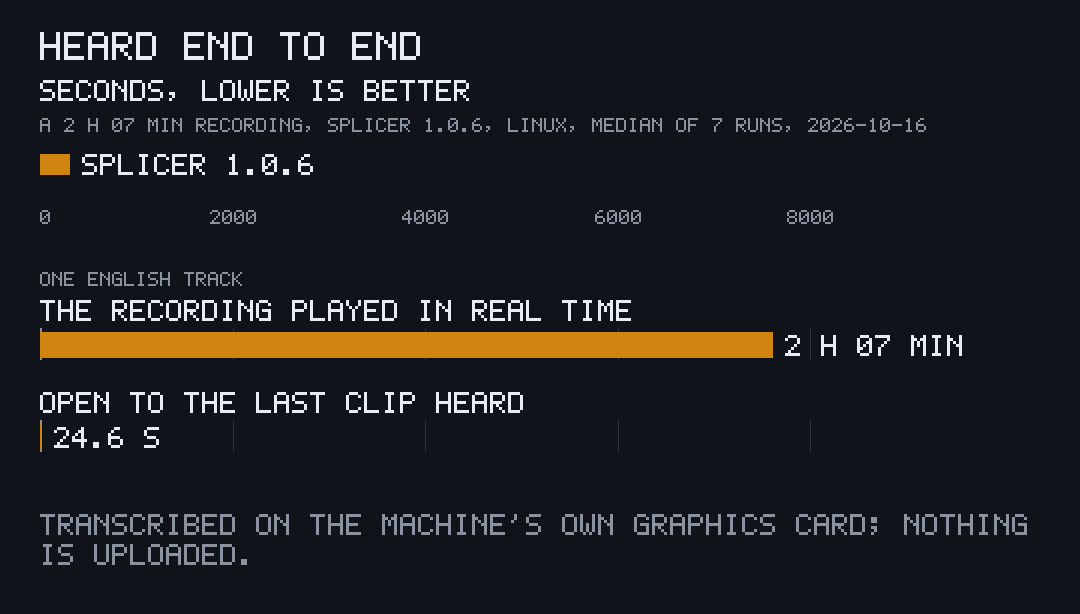
- 24.6 s to hear all two hours and seven minutes on your own graphics card
- 0.61 s to the first clips of a 122 GB recording, in 806 MB of memory
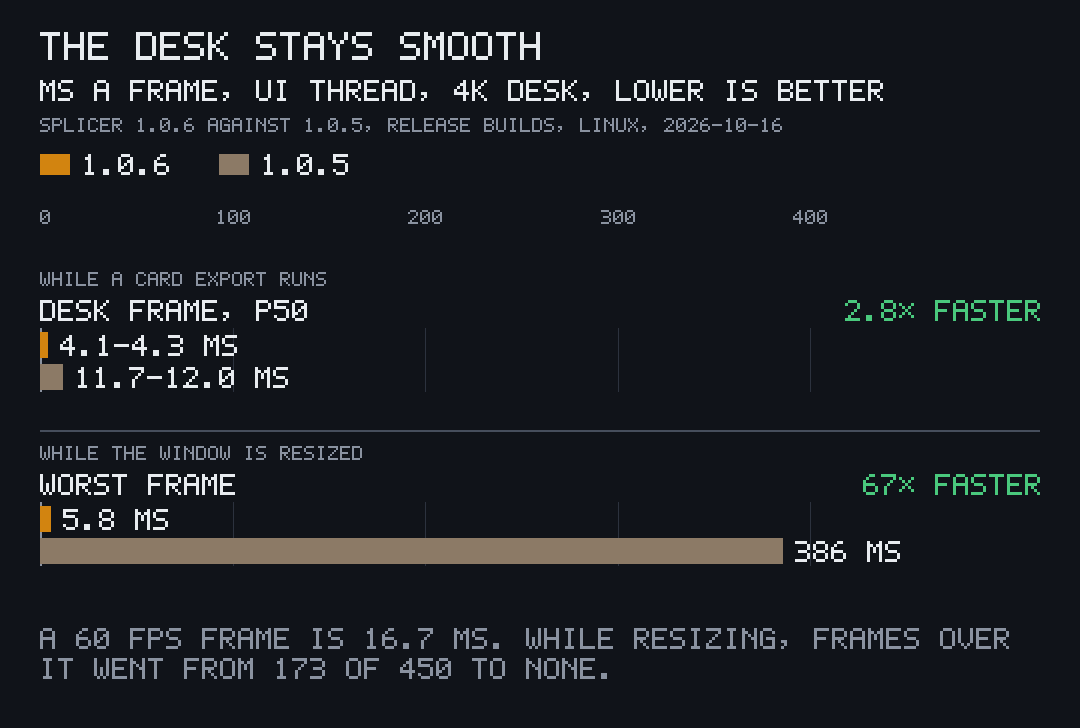
- 4.1 ms a desk frame while an export runs beside it
Release by release
| What | Measured | Release |
|---|---|---|
| Open the two-hour recording: the first clips ready to keep or drop, on the command line | 1.02 s | 1.0.0-rc.1 |
| Open the two-hour recording: its first frame, on the command line | 59 ms | 1.0.6 |
| Open the two-hour recording: every clip heard, on the command line | 24.6 s | 1.0.6, against 24.8 s in 1.0.4 |
| The desk while the two-hour recording opens: its own work per frame, p99 | 2.6 to 5.3 ms | 1.2.0, four runs |
| A screenful of 27 rail pictures: a 10-minute MP4, then the two-hour MKV | 24.4 ms, 60.8 ms | 1.0.7 |
| Open a 122 GB recording: first clips, memory peak | 0.61 s, 806 MB | 1.0.0-rc.1 |
| An AV1 video, 720p, two minutes: first frame | 49 to 52 ms | 1.0.5, its own codecs, against 87 to 719 ms in 1.0.4 |
| A Matroska file on a NAS over SMB: open to first frame | 27 to 79 ms | 1.0.1, against no picture for 30.6 to 34 s in 1.0.0-rc.15 |
| Silences removed, the first 20 minutes of the two-hour file: smart cut | 24.5 s | 1.0.4, against 32.0 to 33.8 s in 1.0.2 |
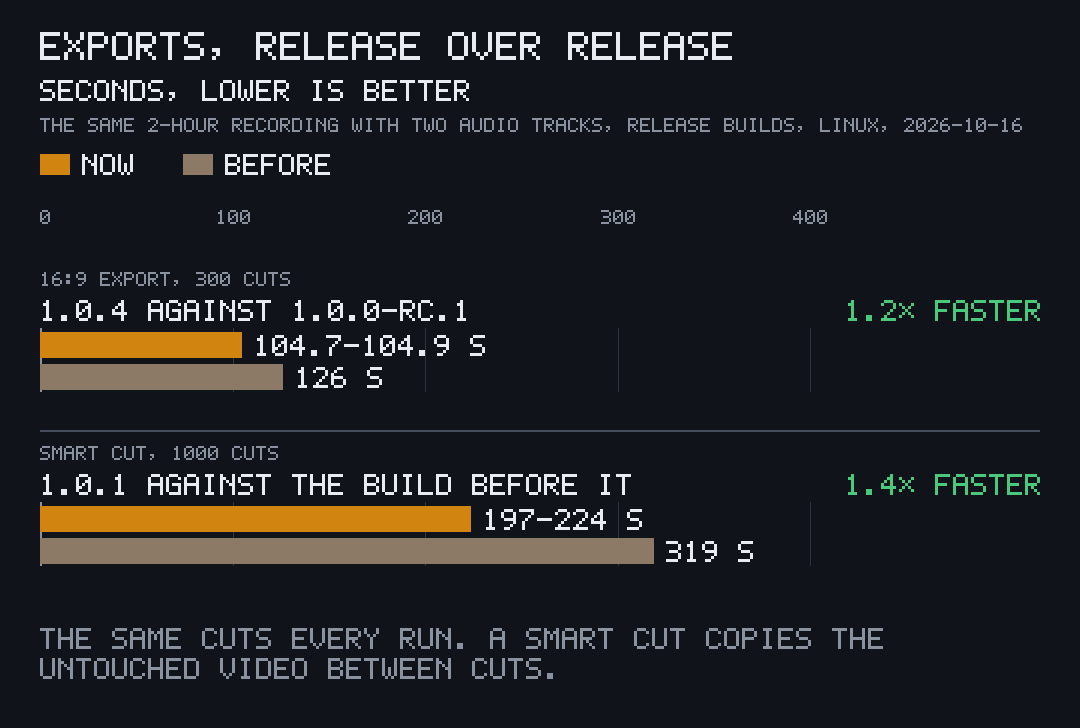
| 1000 cuts of the two-hour, two-track file: smart cut | 197 to 224 s | 1.0.1, against 319 s before it |
| 300 cuts of the same file, 16:9 export | 104.7 to 104.9 s | 1.0.4, against 126 s in 1.0.0-rc.1 |
| A desk frame while a card export runs beside it, p50 | 4.1 to 4.3 ms | 1.0.6, against 11.7 to 12.0 ms in 1.0.5 |
Hearing runs on your own graphics card: the two-hour recording is heard on an AMD Radeon RX 9060 XT. Every number comes from Splicer's speed baseline, which each release candidate is measured against.