Got questions or doubts?
Ping me on Discord
pfx's speed, measured
2
0
ms
An idle frame
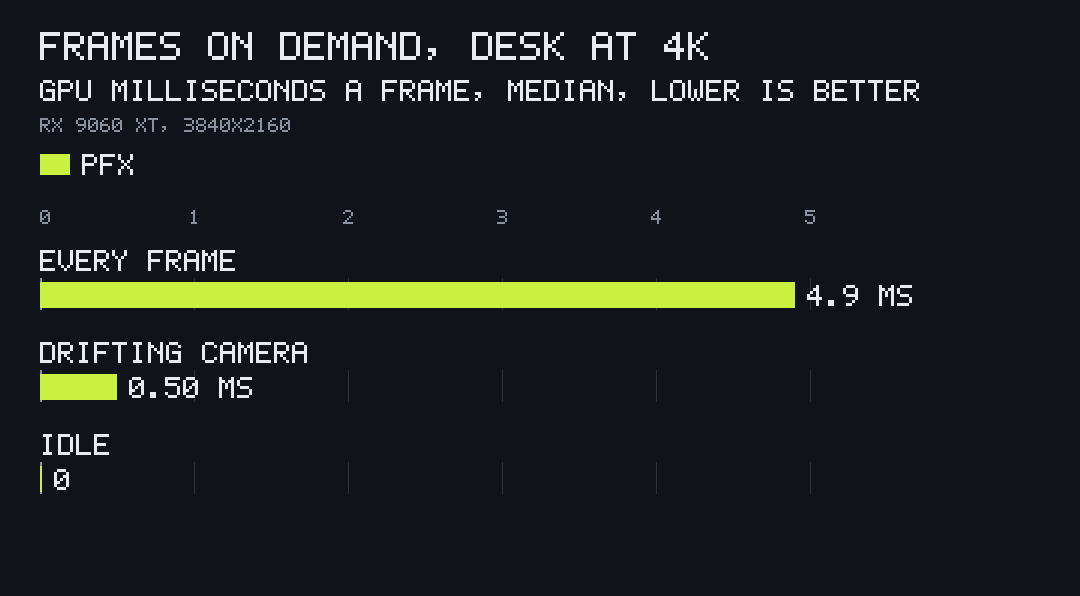
a drifting camera 0.50 ms, every frame 4.9 ms
docs/measured.md
3
33.7
MB
Empty game, shipped
with its content, against Godot's 73.5 and Bevy's 106.6 MB
Against other engines
4
3.4
ms
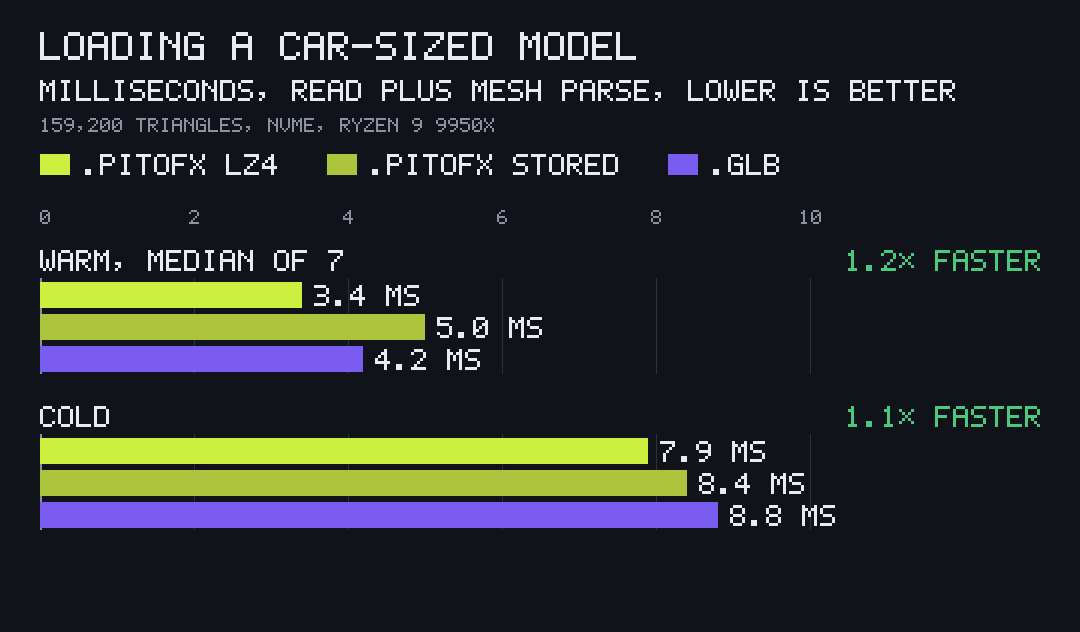
A .pitofx model, warm
159,200 triangles, against the GLB's 4.2 ms
docs/pfx-file.md
5
5,969
ms
Path-traced 4K still
the workshop, adaptive to 64 samples
docs/trace.md
Every number was measured on pfx's own code, on an AMD Radeon RX 9060 XT
with an AMD Ryzen 9 9950X under Linux, each GPU run through a GPU queue
other jobs shared. pfx's docs give the command behind each one.
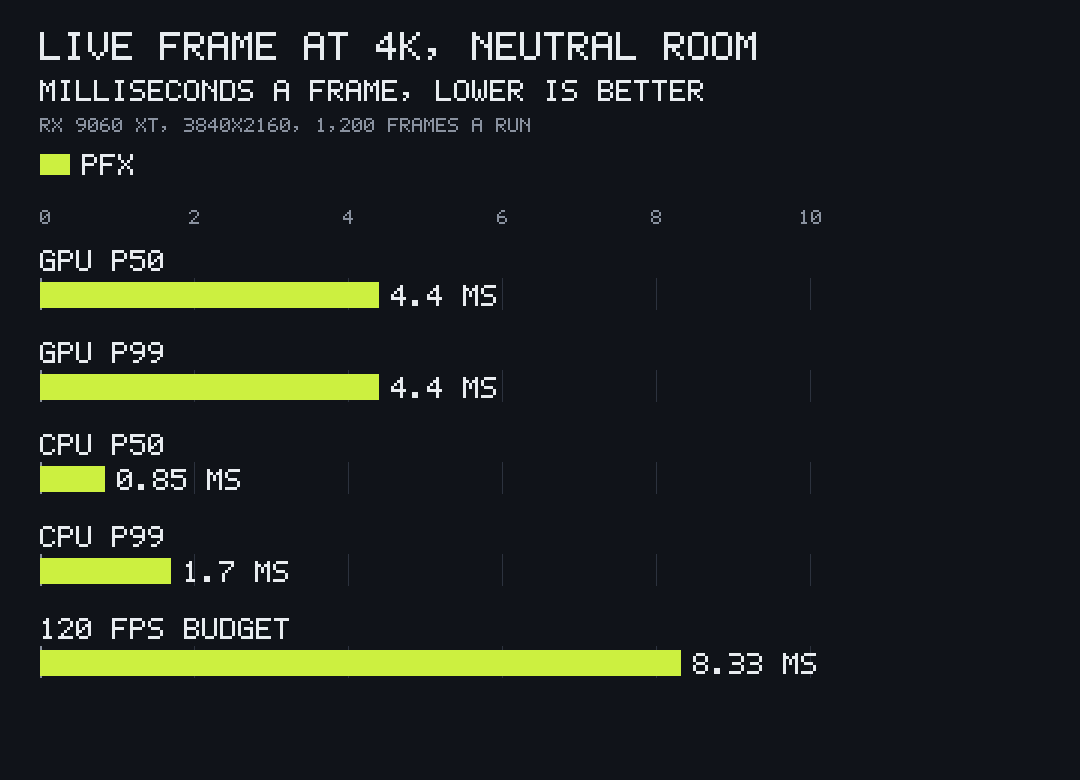
The neutral room at 3840×2160, 1,200 frames a run, the median of five runs: 4.4 ms of GPU at p50 and at p99, about half of the 8.33 ms a 120 fps frame allows, with the rest left for the game. The CPU's simulate-and-submit takes 0.85 ms.
Method: docs/measured.md
pfx draws a frame only when something changed. On the desk at 4K a full frame costs 4.9 ms, a drifting camera 0.50 ms, and and an idle scene 0.
Method: docs/measured.md
3
Many lights, one sample
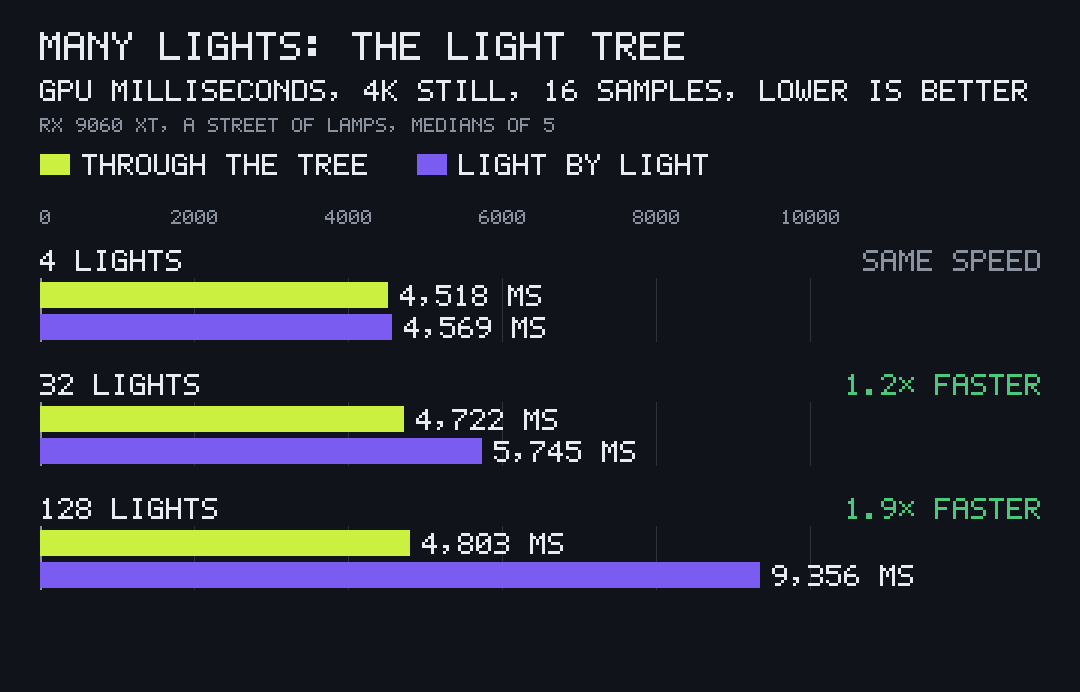
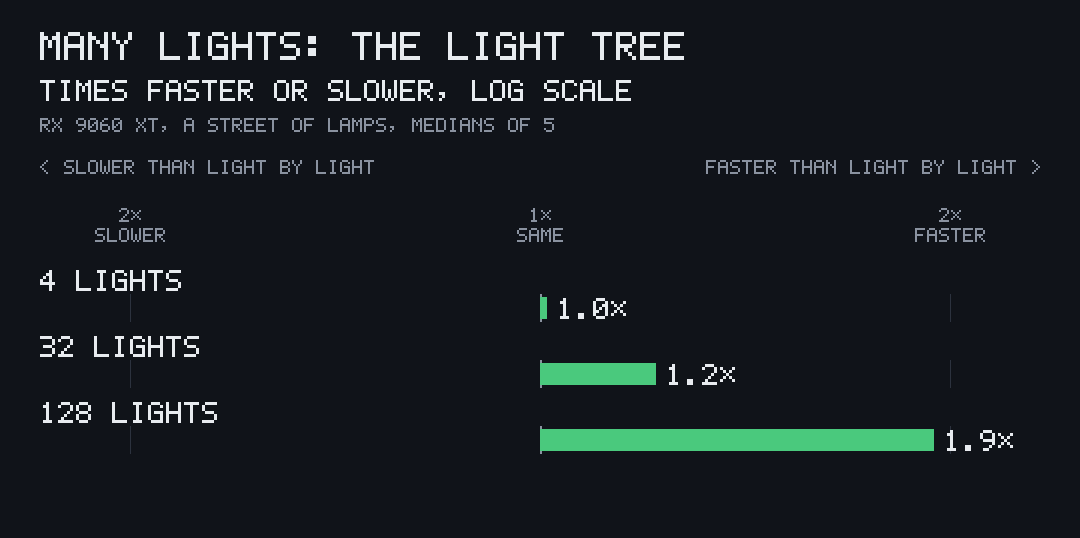
Past four point and spot lights, the tracer picks one light per bounce through a light tree ported from Cycles. A street of 128 lamps at 4K traces in 4,803 ms, against 9,356 ms light by light; 128 lights cost 6% more than 4.
Method: docs/trace-lights.md
4
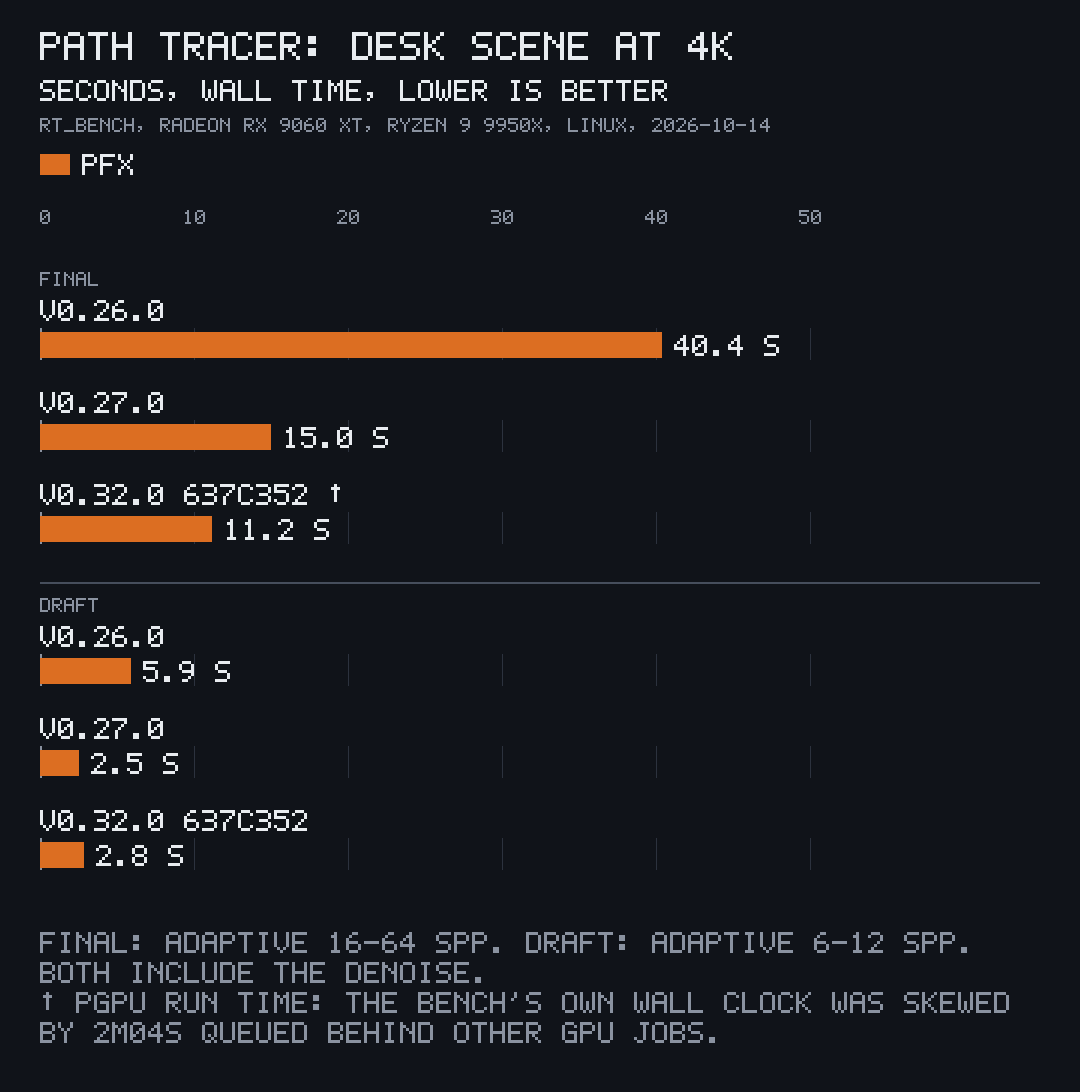
The path tracer, release by release
The desk at 4K, path-traced and denoised, in seconds of wall time: 40.4 s at v0.26.0, 15.0 s at v0.27.0 and 11.2 s at v0.32.0 for the final picture, and 5.9 s, 2.5 s and 2.8 s for the draft. Same desk, same card.
Method: docs/trace.md
5
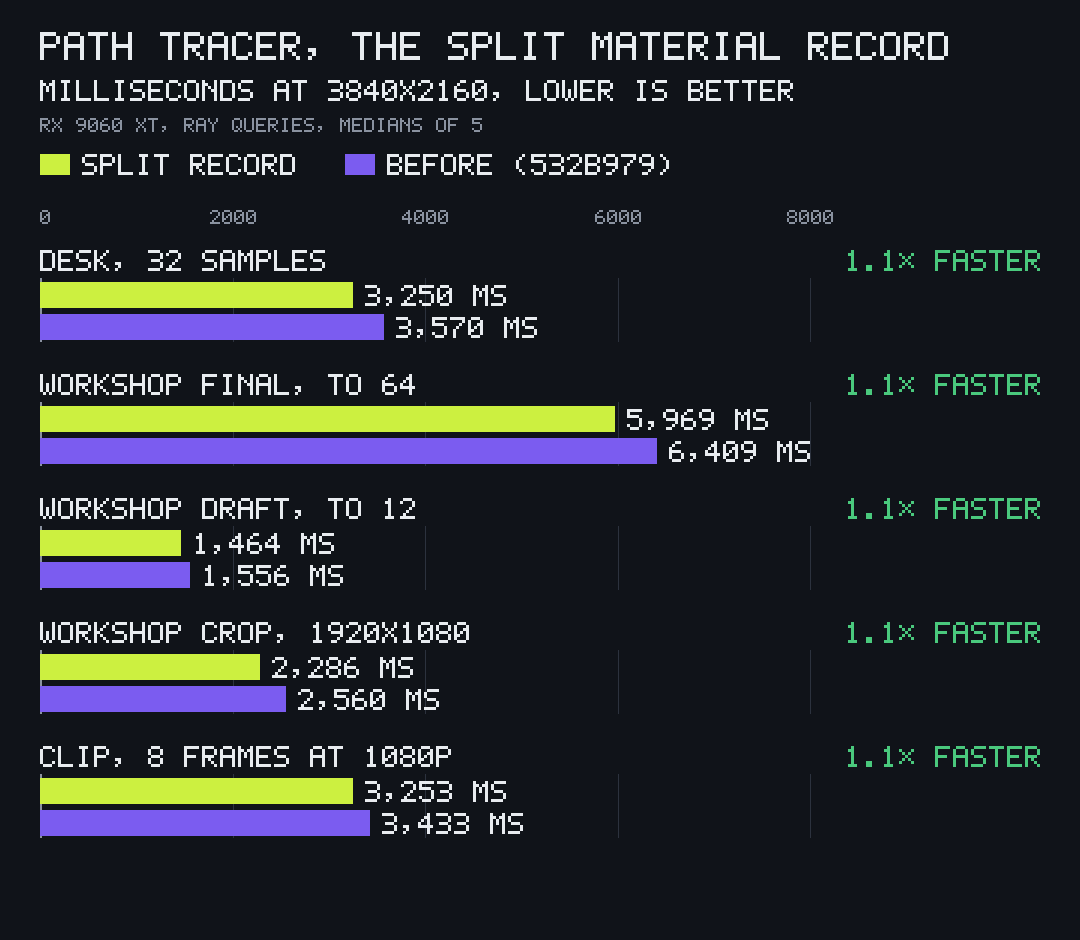
The path tracer's material record
Each material is split, as Cycles lays out its shaders, into a 128-byte hot record every hit reads and extension rows only the materials that use them carry. At 4K with ray queries, every still got 5.2% to 10.7% faster and every output stayed byte for byte the same.
Method: docs/trace.md
6
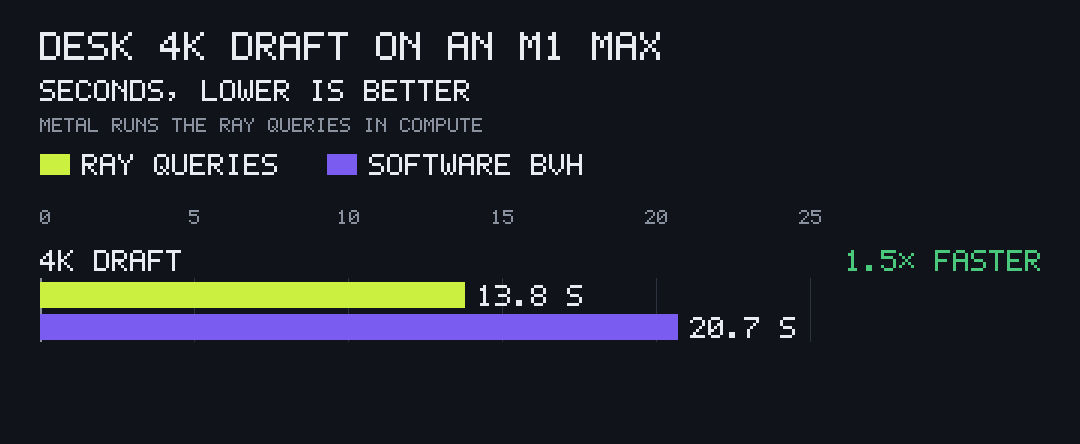
Ray queries on Apple Silicon
Where the device offers ray queries (Vulkan, DX12, Metal on Apple Silicon) the tracer uses them, with its own BVH elsewhere. On an M1 Max, which runs the queries in compute, the desk's 4K draft takes 13.8 s with ray queries and 20.7 s on the BVH.
Method: docs/trace.md
7
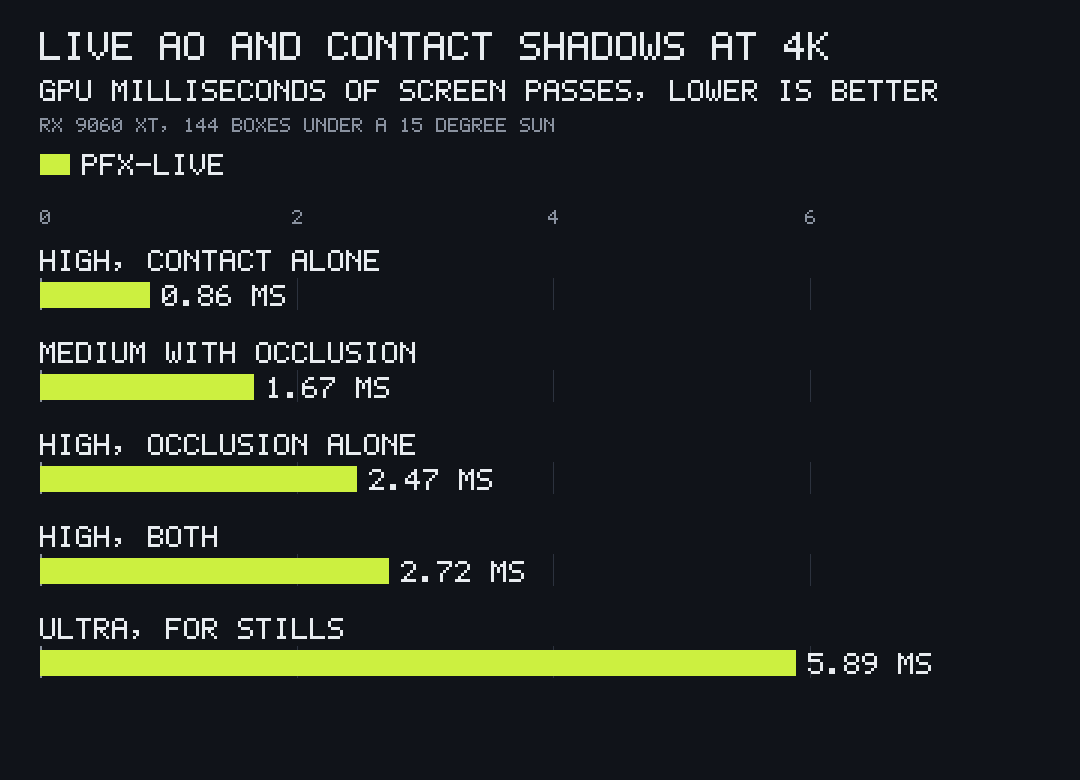
Live AO and contact shadows
XeGTAO's ambient occlusion and Filament's contact shadows, ported, ground what rests on the floor. At 4K the high preset's screen passes take 2.72 ms; ultra is for stills.
Method: docs/live-renderer.md
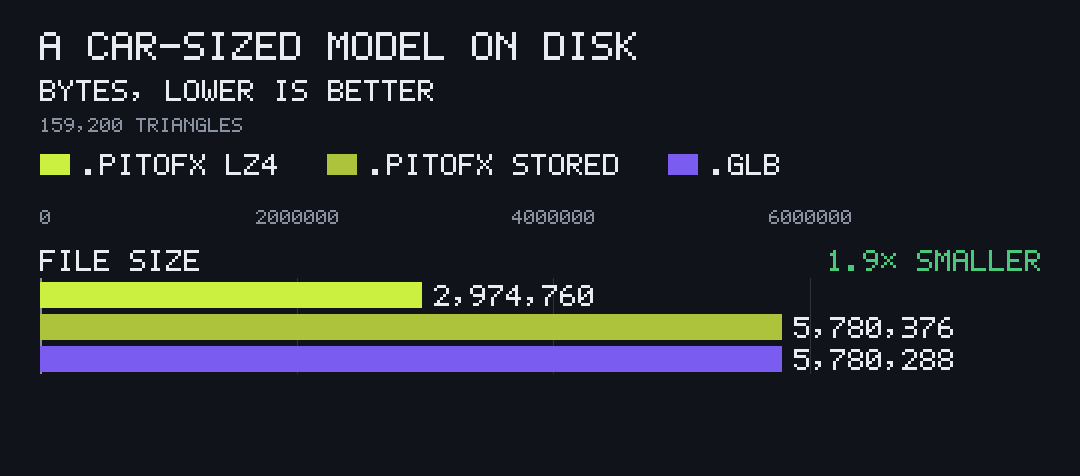
A car-sized model of 159,200 triangles: LZ4 takes the file to 2,974,760 bytes from the GLB's 5,780,288, and it loads in 3.4 ms warm and 7.9 ms cold, against the GLB's 4.2 ms and 8.8 ms.
Method: docs/pfx-file.md
9
The denoiser by frame size
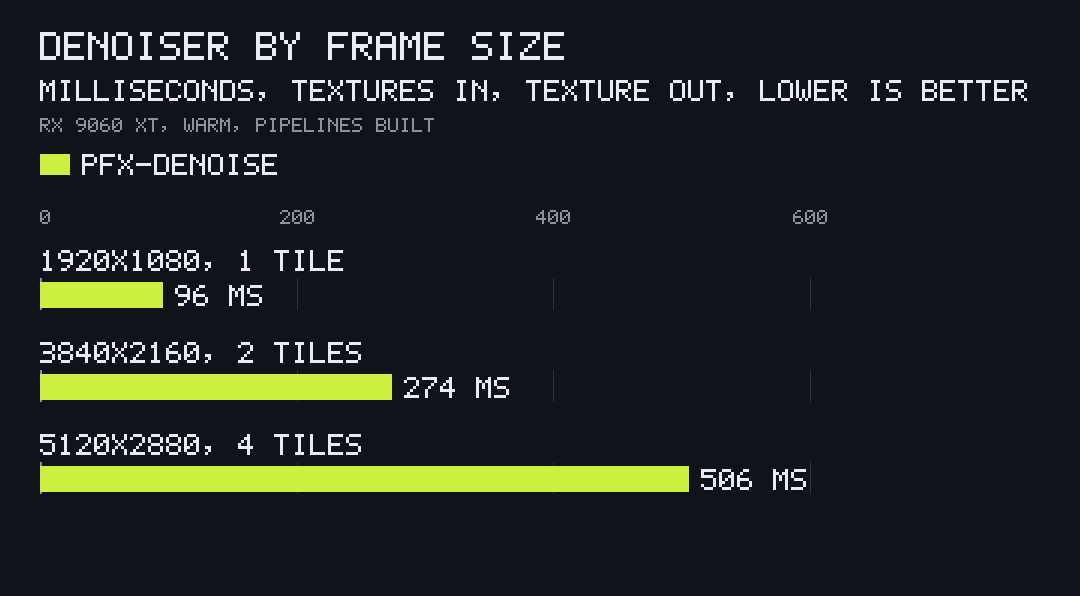
Textures in, texture out, warm: 96 ms at 1080p, 274 ms at 4K and 506 ms at 5K; with upload and readback, 110, 452 and 732 ms.
Method: docs/denoise.md
10
The rest of a game, per tick
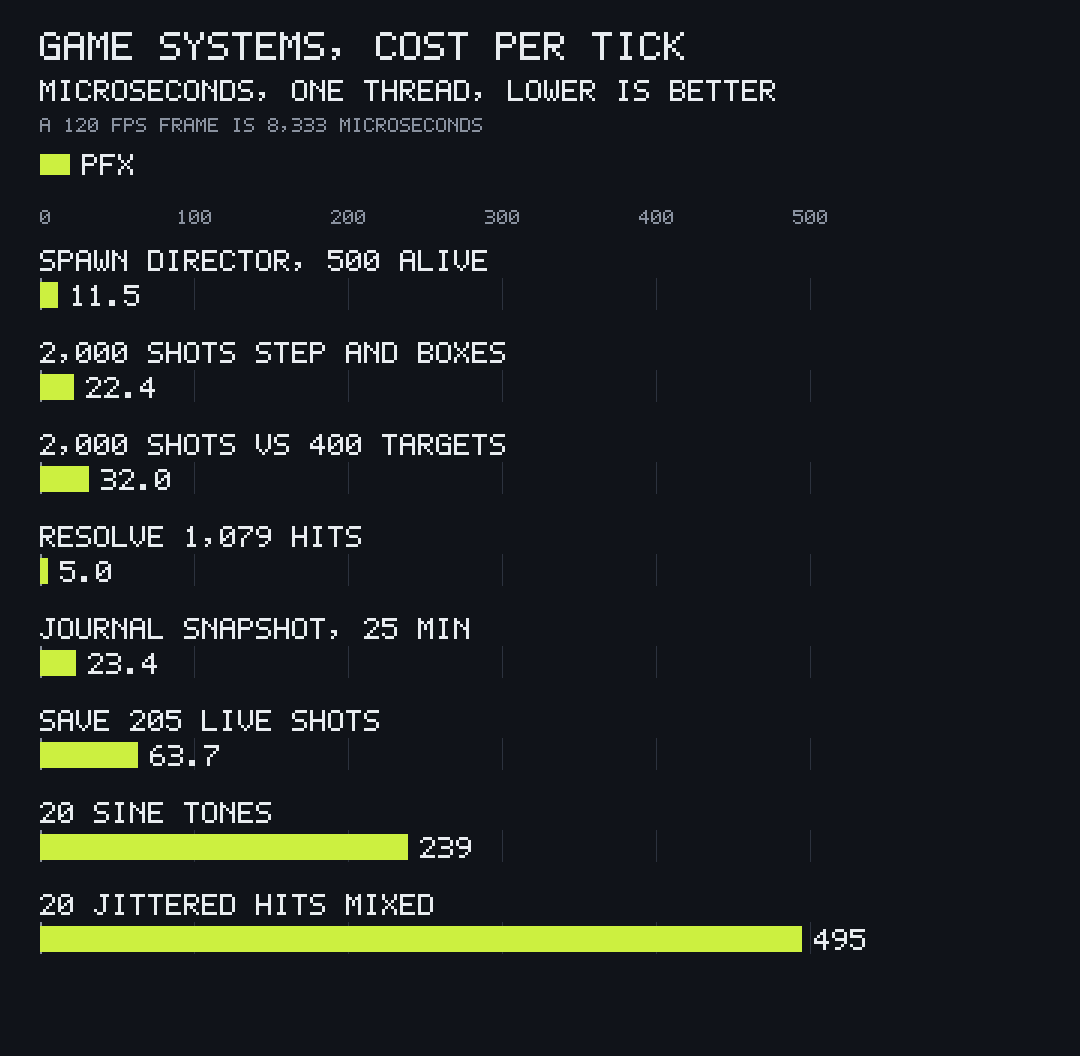
The game systems' benches, one thread, in microseconds. A 120 fps frame is 8,333 of them; the largest here is 495.
Method: docs/measured.md
Measured on 2026-10-19 and 2026-10-20 under Linux x86_64. Each row names what was measured and how; lower is better
everywhere.
| Measured |
How |
pfx |
Against |
| Download |
Linux x86_64 |
37.5 MB |
Godot 4.7.2: 77.9 MB
Blender 5.2.2: 383 MB
|
| On disk |
unpacked |
84.4 MB |
Godot 4.7.2: 146.4 MB
Blender 5.2.2: 1,236 MB
|
| An empty shipped game |
with its content (a 29.1 MB binary), no editor |
33.7 MB |
Godot 4.7.2: 73.5 MB
Bevy 0.20.0: 106.6 MB
|
| The editor's first frame |
warm caches, an empty project |
0.52 s |
Godot 4.7.2: 2.18 s
|
| The editor at idle |
CPU, of one thread |
0.05% |
Godot 4.7.2: 3.2%
|
| The editor's memory |
an empty project |
180 MB |
Godot 4.7.2: 1,064 MB
|
| An empty game at idle |
CPU |
1.05% |
Godot 4.7.2: 4.1%
|
| An empty game at idle |
GPU. pfx presented no frame in 20 s |
0% |
Godot 4.7.2: 0.94%
|
| A running empty game |
memory |
156.3 MB |
Godot 4.7.2: 261.2 MB
Bevy 0.20.0: 255.1 MB
|
| Change one value, get a file to ship |
pfx set and pfx build; Godot: edit main.tscn, export the pack headless |
63 ms |
Godot 4.7.2: 2,340 ms
|
| Import a glTF |
a 6.8 MB GLB |
46 ms |
Godot 4.7.2: 2,479 ms
|
| Build a game from source |
a clean release build |
87.4 s |
Bevy 0.20.0: 180.4 s
|
| Rebuild after one change |
touching main.rs |
0.96 s |
Bevy 0.20.0: 1.63 s
|
Build on pfx
pfx is open source under the AGPL-3.0: free for open-source
projects, learning and hobby work. Read it, fork it, and
send issues and pull requests on GitHub. Closed products and
services built on pfx take a
licence: free under $200k of
yearly revenue plus funding, Indie and Pro above it.
© Catalin Ilinca, AGPL-3.0-only, with
licences for closed products;
releases up to 3.1.1 remain MIT. The PITO MD name, the pfx
name and its logo are © Catalin Ilinca, all rights reserved.
Every picture and clip on this page is pfx's own, rendered or
captured from its neutral scenes and licensed with its code
(pfx's NOTICE.md); the pfx gui and game-editor clips were
recorded by pfx from its v3.0.1 tag, the terminal
clips with prec,
the loops encoded with pito-codecs
and the charts drawn with
pito-compare from the numbers pfx
v3.1.2 measures. Type: Exo 2 by NDISCOVER (
SIL Open Font License 1.1
) and JetBrains Mono by JetBrains (
SIL Open Font License 1.1
), from pfx's theme.