Filmstrips that keep up
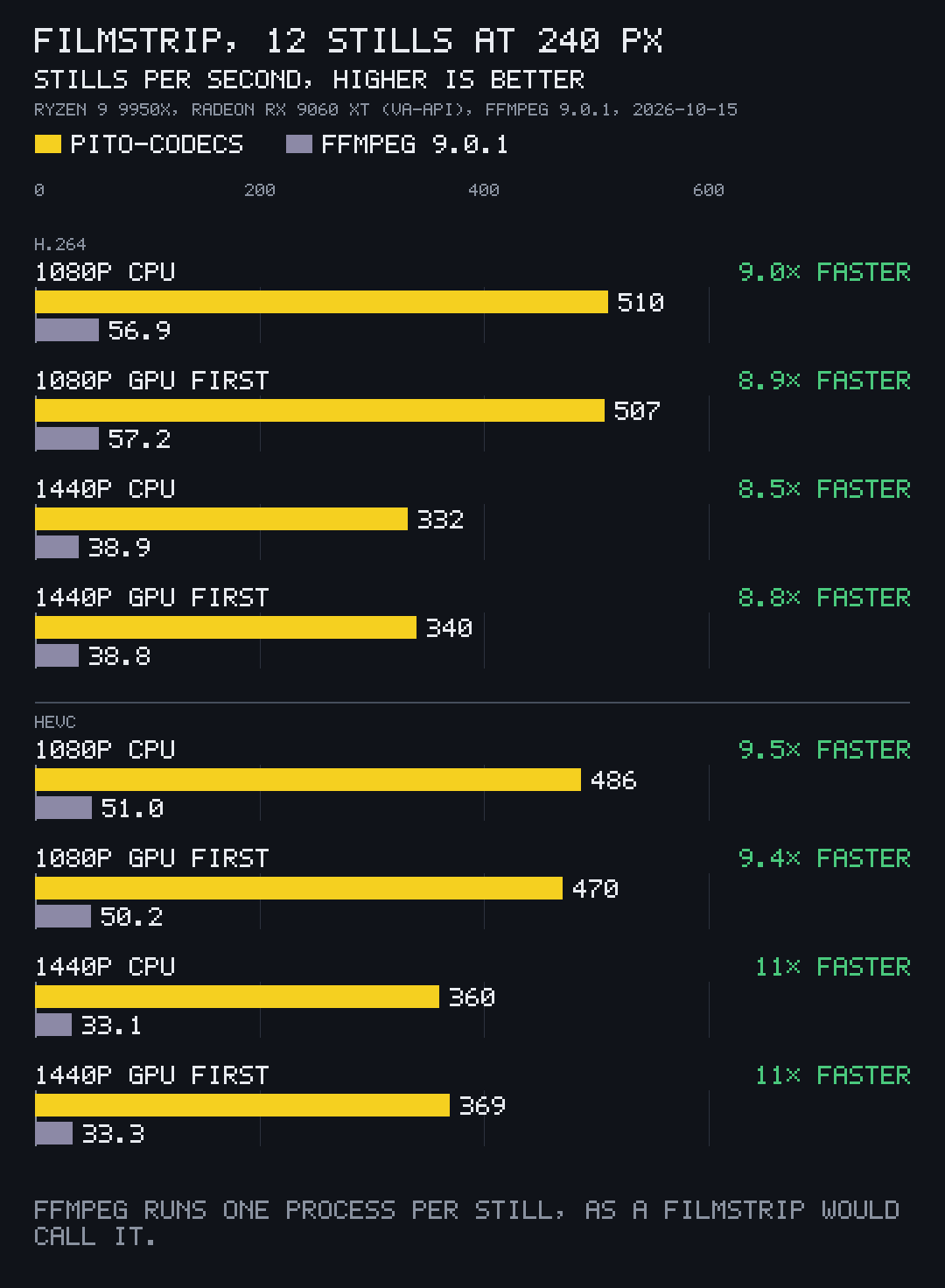
12 stills at 240 px in 24 to 36 ms, 9× to 11× faster than ffmpeg, which runs 12 processes, 8 at a time.
What it does
frames_at takes stills at any times, from the keyframe at or before each one, and reads only what it needs. In MKV and WebM it seeks through the file's Cues, so a still late in a long recording costs the same as one at the start. frames_at_seek with Seek::Exact decodes on to the exact frame.
The strip above was made from twelve stills taken by frames_at (a GIF pito-codecs' own encoder wrote in 27 ms).
Against ffmpeg, pito-codecs takes all 12 stills in one process; ffmpeg runs 12 processes (-noaccurate_seek), 8 at a time, as a filmstrip would call it.
-
A handle that keeps its decoders
An app that asks for stills again and again keeps a
Stillshandle:Stills::openopens the file once, andstills.framesreuses its decoders across calls and hands each still over as soon as it is decoded, in any order. -
Memory you can cap
A handle runs and keeps up to 16 decoders;
stills.keep(n)caps both andstills.trim()drops the kept ones when the app goes idle. With three handles open, keeping 4 decoders each brings the process's peak from 916 MB to 442 MB. -
Contact sheets from the command line
pcod stillswrites N evenly spaced stills or stills at given times, as PNGs into a folder and as one contact sheet, through pito-codecs' own PNG encoder.
Measured
- 12 stills at 240 px, 9× to 11× faster than ffmpeg running 12 processes, 8 at a time
- 24–36 ms
- How it was measured
- stills of a 1080p H.264 file on the CPU; ffmpeg 57, running 12 processes, 8 at a time
- 510 / s
- How it was measured
- stills of a 1440p HEVC file, GPU first; ffmpeg 33, running 12 processes, 8 at a time
- 369 / s
- How it was measured
- a 24-still filmstrip at 90 px of a 120 s 1080p file on a kept handle; 22.5 ms through separate calls
- 10.8 ms
- How it was measured
- a 24-still contact sheet of a 10-minute 1080p file on the GPU route; ffmpeg's filter chain 5.2 to 6.6 s
- 0.54–0.62 s
- How it was measured
How to use it
-
A contact sheet and the PNGs behind it:
pcod stills clip.mp4 --count 24 --cols 6 --sheet sheet.png --out stills/ -
Stills at given times, each listed with its time, size and path:
pcod stills clip.mp4 --at 90,1:30,1:02:03.5 --out stills/ --json -
In Rust, stills at 60 s and 90 minutes, 120 px tall:
let strip = frames_at("recording.mkv".as_ref(), &[60.0, 5400.0], 120, &prefs)?;