
pito-tui, measured
The loop draws at most one frame every 8.333 ms (120 fps), batches every wake that came in since, and draws nothing while nothing changes. Drawing reads the loop's moment, never the clock or the input, so a frame costs only the drawing.
Frame times
The mean and the worst of 1,000 frames for each screen of the demo, at two terminal sizes.
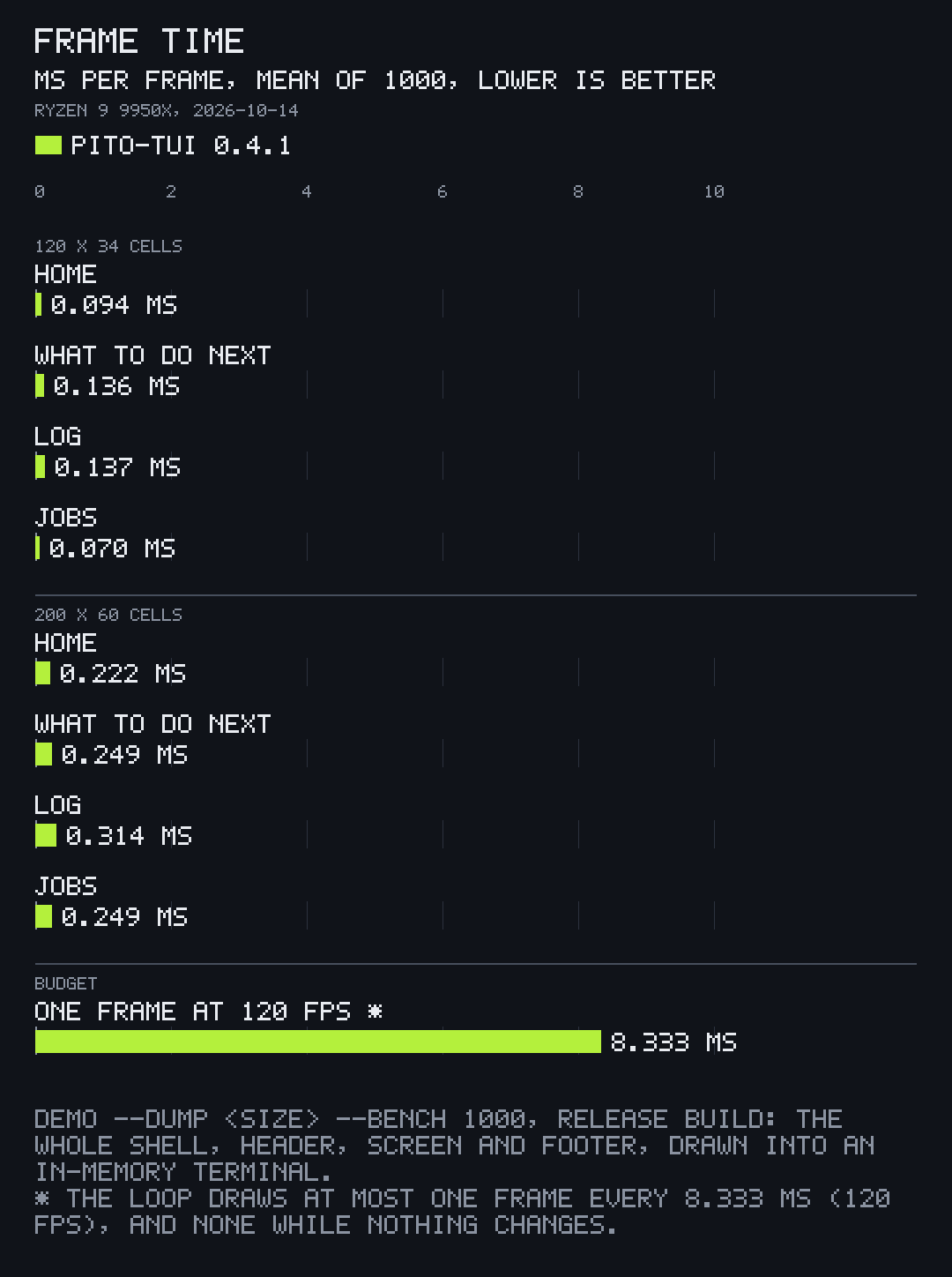
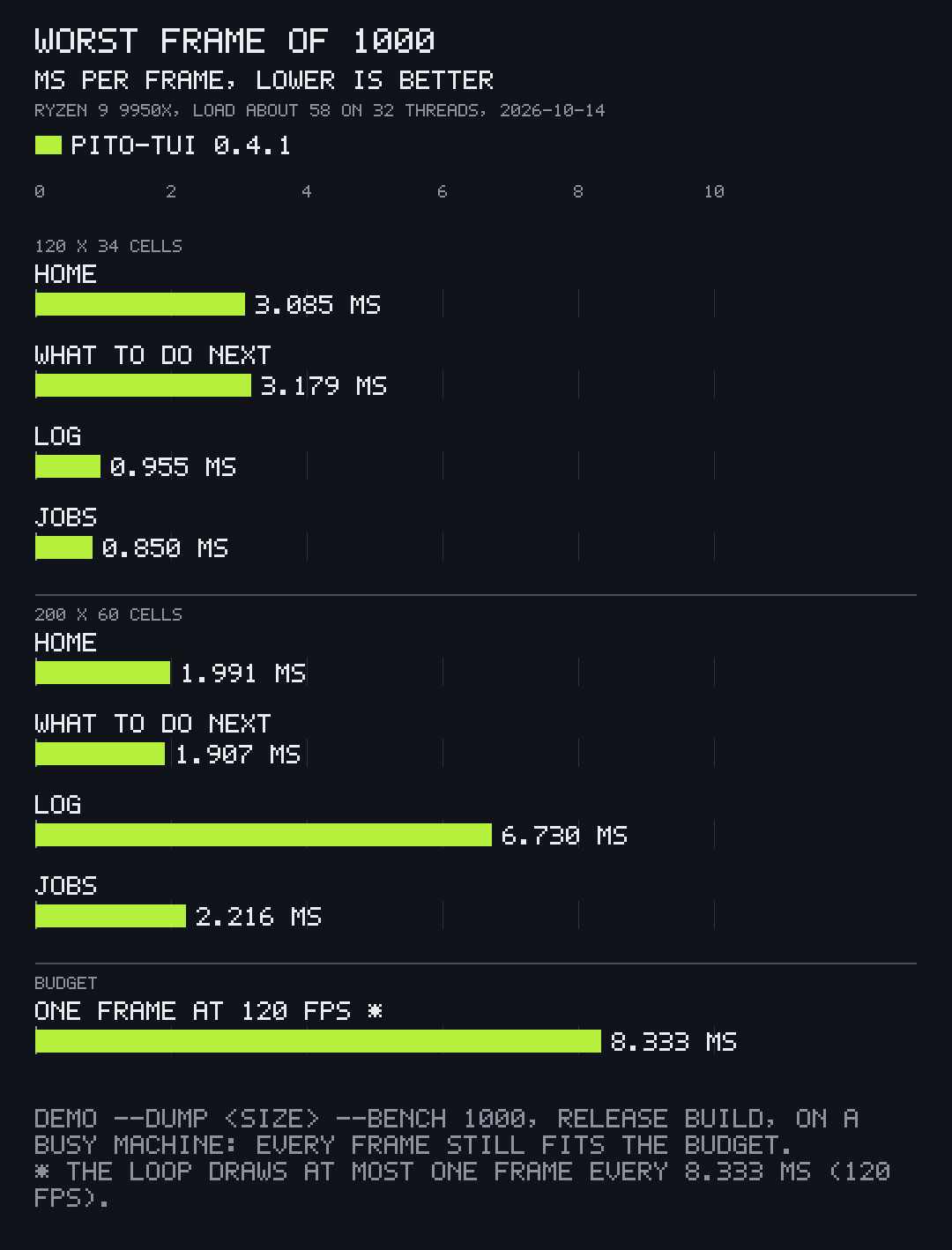
Every screen of the demo
The mean and worst frame of each screen, at 120x34 and 200x60 cells.
| Screen | 120x34 average | 120x34 worst | 200x60 average | 200x60 worst |
|---|---|---|---|---|
| Home | 0.094 ms | 3.085 ms | 0.222 ms | 1.991 ms |
| What to do next | 0.136 ms | 3.179 ms | 0.249 ms | 1.907 ms |
| Log (20,000 lines) | 0.137 ms | 0.955 ms | 0.314 ms | 6.730 ms |
| Jobs | 0.070 ms | 0.850 ms | 0.249 ms | 2.216 ms |
How it was measured
Once, on 2026-10-14: demo --dump 120x34 --bench 1000 and --dump 200x60 --bench 1000 on the release build of pito-tui 0.4.1 (rustc 1.97.1; 1.0.0 draws with the
same code), an AMD Ryzen 9 9950X on Linux. Tui::bench draws each
screen 1,000 times into an in-memory terminal, the whole shell each time,
moving the clock a frame at a time. Not measured on macOS or Windows.
The same day and machine: the demo's release build is 2.3 MB, 1.7 MB
stripped; src/ is 8,768 lines of Rust, tests included; the crate
has 11 direct dependencies and 71 in all on Linux; a clean release build of
the demo, every dependency included, takes 39 s.
Every number is from pito-tui's README at v1.0.3.
Read it. Run it. It's MIT.
The code is MIT licensed, © Catalin Ilinca: read it, fork it, ship it in your own work. Its name and logos, and PITO MD's, are © Catalin Ilinca, all rights reserved, and are not covered by the MIT licence.